Thursday, October 13, 2011

Falling Apart at the Seams

We had a little bit of an incident today with the wagon. Buck and Charlie were giving their usual wagon ride to the residents and practicing for the upcoming spooky Halloween parade. They were a tad antsy, but considering their usual rock solid performance, their antsy-ness was mild. It could be that some of this was related to the low tire on the wagon that expressed itself after the large load of boys climbed aboard, and we went through a series of ruts in the road. Coming down the hill back into campus, however, something went wrong. Something on Buck’s harness snapped. Thankfully, they listened to their driver though the ruckus and stopped, though they had a little trouble slowing the heavy wagon rolling behind them. I helped to unhitch the poor sweaty horses and the boys had fun hauling the wagon back to the barn. We then sadly inspected the torn, weakened, and falling apart set of harnesses.

It’s kind of how I’ve been feeling lately. Like I’m falling apart at the seams. The past few months have been pretty rough for me. I’ve been bucked off of a few horses, dealt with what seems to be a permanent pulled muscle in my back, and the rest of my body parts seem to be resisting the compensation that they are having to do. I am tense, stiff, and braced, and I know that my horses notice. I am not sleeping well, have gained weight, and have a tough time keeping my mind on work.

All this I have just been dealing with like it is normal. Well, I’m thirty now, I think sometimes, its just how it is.... When Lucy finally was the one to unseat me I started to take notice. I have been reading a book by Mark Rashid, one of my favorite authors, “Horsemanship Through Life”, which talks about his journey to learning how to take care of what needs taking care of, and going with life instead of bracing against it. As I began to read his story (which was sounding exactly like mine), it all started to make sense.

Harnesses and bodies and minds all need regular attention to ensure that they will continue to work properly. When one thing gets out of whack, it affects all the rest. Setting the one thing right quickly can make things easier. When it’s let go for a long period of time, other parts start needing attention too, and soon the damage can take a lot to fix. Usually by the time we are falling apart at the seams, it almost seems to overwhelming to try to get it back together, and sometimes it takes something snapping to get our attention.

I start physical therapy on Monday (I’ve only had the referral for two months...). I suppose losing weight is also in order, as well as making the time for a regular yoga practice. None of it will be easy. But thank God for horses who manage in situations where everything is falling apart, and help urge us to take notice.
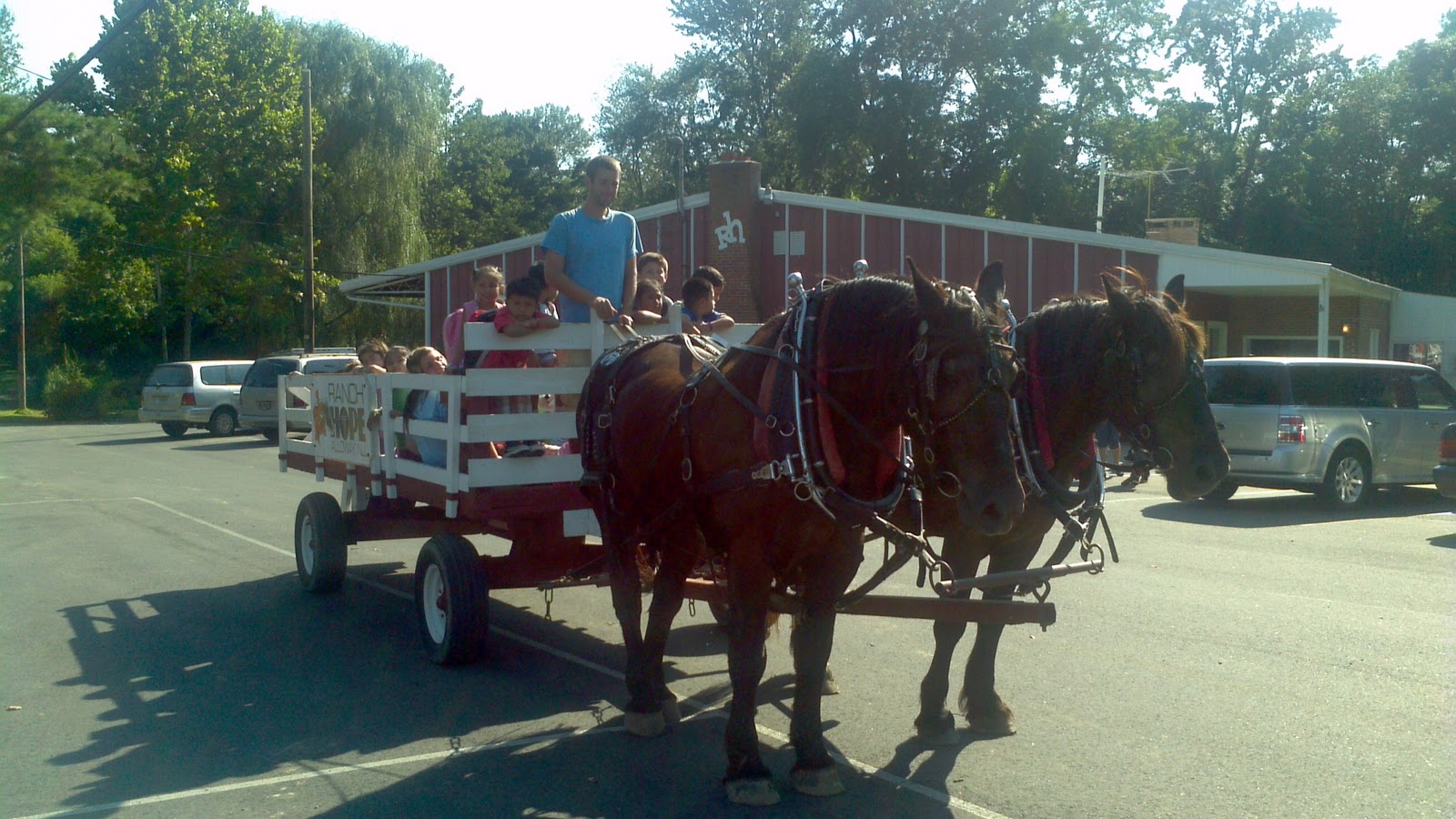
Buck and Charlie pulling their precious load

Sunday, October 2, 2011

All Together Now


As Lucy and I are apt to do, we spent Saturday morning giving a riding lesson to a young girl. Bailey has been riding Lucy for a few weeks now and the two get along very well. This particular day was a very interesting lesson for us all. Not too far into the lesson, Bailey for some reason sat down on a tire and began to cry. It seems she was having a bad day. Well, nothing better for a bad day than a horse, I say, and we get on with the lesson. Bailey continues to work through her tendency to give up easily, and her confidence grows through the lesson, culminating in her pulling from seeming out of nowhere some really nice posting.

It was a sunny day, the lesson went well, Bailey was fun to be around, and I was with horses. But that all did not account for the fact that I left the farm that day with the accomplished feeling like I had learned something. And I felt like Lucy had learned something. I knew what Bailey had learned, but had a really hard time putting my finger on what I had learned, or Lucy for that matter. This feeling was pretty puzzling. Not that I am unused to coming away from my time with horses having learned something, but the trouble is, I was not sure what exactly I had learned.

I felt pretty lucky that day, to have learned whatever I learned, but now that I think I know exactly what it was that I learned, I feel even luckier. My feeling is that I had the rare opportunity to experience something that horses experience all the time, a herd mentality. This term tends to have some negative connotations to people who do not understand horses. However, horses do not think as we do. They are always thinking in terms of the herd, and the relationship.

There are countless times that I have seen how horses think as a herd in a helpful way. Trimming hooves in a herd is one time that I see this often. I will be trimming one horse, and another will be on standby to “help”. One time in particular, I was trimming Ceasar’s hooves, who can at times have a hard time with his balance in the situation. As I was placing his front hoof on the stand, he struggled, and Lucy, who was on standby, moved forward and put her nose in the situation. When Ceasar got himself together, Lucy started licking and chewing.

This past weekend, I went to a clinic and observed a group of individuals learning new things with their horses. I was drawn to watch the horses themselves as the instructor stood in the middle and they all circled around, as though even the horses were listening and committed to learning. At one point, the instructor was working with his horse on accepting the scary tarp. All the other horses were quite alert to the situation. Then, just before the instructor’s horse visibly made a shift in his thinking, one of the observing horses sighed and started licking and chewing.

I have seen horses take the initiative to stop moving to ease their rider’s worry just before their legs begin to tremor. I have had horses tell me about their herdmate’s illness. I have had them come over to the arena to help when the horse I am working with is having trouble. I have seen Lucy in a therapy session act out exactly what the group was talking about when they were discussing their obstacle course. I have told a sick horse in English words to eat his food because I wanted him to live, and he complied.

These things happen all the time with horses, only we tend to not notice them. Horses are committed to the herd, whether it be the one they live with every day, or the one they are with in the moment, or the one we create in our relationship with them. When something good happens, it belongs to the whole herd, when something bad happens it happens to the whole herd. Horses do not think in “I”, they think in “We”.

We can have the same mentality with our horses and with each other, but we tend to create more fights than needed, and think that we need to forward our own needs before others. Humans have the capability to think together on amazing levels that we rarely explore. The key may be to start noticing where we do connect. Those moments where we finish each other’s sentences, have the same ideas, or empathize with each other’s feelings should not be shrugged off. If we believe the herd is important to our well being, it will affect the herd. We will all be in a better place, if we are in it together.

Friday, September 23, 2011

A Farm Full of Lonely Horses

Today I visited the farm of an elderly couple who was having trouble caring for their horses, and had been for quite some time. It was full of beautiful arabian mares and stallions who were clearly well-bred, smart, and athletic, with so much potential. However, the future for these horses is dim. So is the barn that all 11 stallions reside in most of their lives. Some of the mares were friendly. Most were stand-offish at best. Though the condition of the farm was poor, the horses appeared well nourished, but it was the seeming lack of love or purpose that these horses had that bothered me most.

One gray stallion had what would seem to be the best view. He had an end stall that got to look out the barn door towards the house. But he seemed so sad. Maybe he watched everyday as his little old owners puttered about less and less. Perhaps his view was the most stressful, watching people come and go, and no one paying any attention to him.

If there is one pure and wholesome lesson that horses teach, it is responsibility. During my 17 years as a horse owner, the lessons in responsibility keep coming. Getting a job at 13 and working through the summer months to pay for my horse was the first. Then came the hard labor, cleaning stalls, barn work, putting up hay. There have been the lessons of emotional commitment, hanging in through the tough times, waiting in the night and the cold for the vet, and the heartbreaking responsibility of making the decision to put an end to a friends suffering.

There is the responsibility of continued learning, always working to be a better horseman, better rider, better person for your horse. And the hard work continues. It never ends, really. All for a horse. Or two or three.... or forty. As much as those beautiful arabians tried to dazzle me, and as much as many horses that I meet try to plant the dangerous seed in my brain that there is always room for one more, I take a loving peek at the horses in my pasture and know that I have all that I need.

You see, my theory is that my utmost responsibility is to the horses that are mine. If I spread my attentions too thin on too many horses, I am not being responsible to my horses. I want to be able to take care of them and be with them until I am old and gray, so I had better not make it too hard on myself. And if I think about it, whenever I return from seeing a lot of horses that want to come home with me, I then see those qualities out there in my pasture. I’ve got a fancy mare, I’ve got a blonde horse, I’ve got one that thinks he’s a stallion. I’ve got all the learning I need out there.

But it doesn’t help me if I don’t pay attention to it. Another theory of mine is that just giving a horse food and water is not taking care of it. They need our love, attention, commitment, and guidance. The main reason that I took on Riley to play with and ride was not because I felt especially drawn to her ( though I do like her a lot), or that I had any designs on her for any particular discipline, but rather because I knew that if she did not learn her manners and lessons, that she may one day take a fairly nice price at the meat market. Responsibility is that serious.

It is that way for our emotional lives as well. As it is for our relationships and endeavors. Responsibility can mean priorities, boundaries, and just plain hard work.

Just giving a horse it’s daily nutrition is no more responsible than admitting to a crime is taking responsibility for your behavior. Or knowing your faults, but not attending to them. Having horses has taught me so much more responsibility than simply shoveling poop and lugging water buckets. We need to take stock of our own pasture, and take responsibility. This means putting a good effort into the things that we need to, paying attention to our faults and holes, and attending to them. We need to look to the future, examine the options, and do our best to take care of what is ours.

Do you have a pasture full of friends that count on you, or a farm full of lonely horses?

Tuesday, September 13, 2011

Letting Go...


Have you ever had 1,500 pounds at the end of a rope leave you with all its might? There might be smaller things at the end of ropes that you may be able to wrestle with, and force to an agreement. There are times when hunkering down and giving a good yank is effective, and there are times when planting yourself like a telephone pole and not giving in gets the message across. Sometimes sheer willpower can overcome a difficult moment, but there are also times when hanging on and pushing through only gets your face dragged through the mud.

After a few bouts of rope burn and hurt feelings while trying to “work though” Riley’s ever increasing obsession with leaving, I realized that I was powerless. There was no way that I would win a fight with that big smart horse on the end of a rope. There was a misunderstanding going on and I could not solve it by digging in my heels.

I decided to drop the rope for a while and play only with Riley at Liberty. With no ropes to foolishly rely on, or more likely get in the way, Riley and I learned a lot about each other. I learned that she had a hard time allowing me on her right side. I learned that when I asked her for a hindquarter disengagement, she sometimes felt pressured. I learned that there was a line down her center of gravity that I could use to encourage forward, or backward. Mostly I learned that Riley was so in tuned to me already, that I had just been giving her sloppy signals, and that is what generally set her off.

As we increased our understanding, we increased our trust. Riley began to look to me for safety and comfort, and I began to take pleasure in playing with her, instead of viewing it as I had been, as “hard work”. I was a little worried to go back on the rope. I was afraid that it all would go wrong again. What I found when we went back online was that all that we had just worked on was there.

We had one fascinating moment of realization for me. Riley got worried and started to think that she should leave. I thought that I had to do what I would do in the round pen, not what I did before that caused the ruckus. I put slack in the line, lowered my energy and focused on my body language. And I saw a shift in her eyes as she found the place that we had at liberty. That place of understanding and trust that we had created, we could instantly go back to when needed.

My moments with Riley continue to have their ups and downs, though I am grateful for them all. She is becoming a lovely horse to be with and ride. She still occasionally has moments in which her life flashes before her eyes and she needs to go. But I understand these more now, and if our communication goes wrong that day, and she gives me more than I bargain for, I let go. And I laugh, and I ask her where she is going, and when would she like to come back? And then we resume our useful conversation, and let the misunderstanding go. And move on.

*********************

I simply must gush about Zeta. At first meet, I fell in love with her. Which probably says something about me, because the first time I saw her she refused to be caught by anyone, and clearly had not been so as evidenced by her baseball bat sized dread-locked tail. As I got to know Zeta better, she showed that she really did seem to have some baggage. Particularly about halters, and face touching, and sometimes people in general. Worming and medication was an issue, as well as the thought of riding. In fact, as I played with her I realized Zeta often seemed to prefer people at her hind end rather than her front end...

My obsession with Zeta continued to grow, and as I usually do with horses new to me, I go in over my head too fast. I misjudged the severity of her issues, and one thing leading to another, Zeta stepped on the much too long rope that I was using, and feeling this pressure on her poll, reactively jerked her head up like a shot, colliding her noggin with mine. Now I’ve been head butted by a horse before, and by horses with much larger heads than hers, but this one hit me just right. I had a nice egg on my forehead, much too gruesome for people to not assume that Zeta was some evil monster of a horse. So even while my head was still swelling, I had to defend my girl. It wasn't her fault, I knew better, she just stepped on the rope, didn't mean it.

As soon as I could make my way back to visit I knew what was on the agenda. Yielding to steady pressure with the halter. I worked on this for one session and made good progress, but I didn't realize quite how much progress until the following time. Zeta began to give to any amount of pressure I put on the halter, not just in a downward force, as I had mostly practiced, but in a tug forward, she gently put her head down. In a request sideways, her head dropped calmly. Compared to the violent reaction of a week before, I was flabbergasted. She had given it up so easily.

This proved to be the way it is with Zeta. Given some gentle communication and understanding, Zeta has been willing to give up her issues with no argument from her. I’ve ridden her several times now, and can tell that she doesn't know much about it. But it is not stopping her from learning and being willing. Clearly the experiences she has had with people on her back have not offered her much connection or communication. But she has gone from repeatedly moving off when mounted to turning her face to me when I put a body part over her back. She has let kids catch her when they are able to slow down their energy and pay attention to their body language.

Zeta has gone from a wild horse to a valuable and important lesson in how to let things go, trust, and move on. She seems to have no hangups about needing to hold on to her old defenses. Certainly they can take some time to disappear entirely, but when she recognizes that there is something better for her, and can trust it,  she does.

Zeta and I on our first ride

Friday, September 9, 2011

Scars and Stripes

All of these lines across my face
Tell you the story of who I am
So many stories of where I've been
And how I got to where I am
But these stories don't mean anything
When you've got no one to tell them to
It's true...I was made for you
- Brandi Carlile


Our scars are a part of who we are. We may not like them, we may think they are ugly or deforming. Or we may think they show character. Most likely we forget that we have them. They can become such a part of our makeup that we no longer remember that they are there. The scars, however, are simply the reminders of how we got them.

I realized recently that my horses have a lot of scars. But I kind of like them. It tells a story, and in many cases, the story of how they came to me. Lucy has some scars on her front shoulder from apparently “leading a wild escape” with the rest of the foals through the fence as a baby. I don’t really know if it was all her idea, but I wouldn’t doubt it. Because of her wounds, and her sweet attitude, she was brought home by a loving lady, and eventually came to me. The wounds healed, and she eventually learned about fences.

Bucky has a similar set of scars on his hind legs from getting caught up in fencing as a baby. I always wonder whether this injury caused him to become the pacer that he is (he prefers to do a lateral moving gait rather than trot). It is curious how our scars may change us, or make us who we are. Yet somehow the change doesn’t seem dramatic, rather just like the tissue growing around the wound, and then eventually fading into our skin, it just becomes a part of us that we hardly recognize where or how it came into being. Bucky also has a nice moon shaped scar on his rear that you can read about in Roll With Resistance.

Ziggy has scars on his knee from his racetrack blowout. It ended his career, but I don’t think it was his passion anyway. He much prefers to use his healing energy (which maybe he gained during his layup) to help his friends, human and equine.

My friend Zeta looks relatively scar free, apart from a band of white hair across her nose where the halter sits. This is likely from her spending many wild years as a broodmare, with little attention, and a halter plastered to her face, because she was “hard to catch”. But this little scar is a great lesson for many boys and girls where she works (as well as myself) of learning to trust, responding to body language, and how to ask politely.

I have a few scars as well, some have stuck around for many years, and some become invisible. But its what happens that causes the scars that says something. It may not even be a thing you can put your finger on. It may say something about who you are, it may mean that you do something differently next time. It may mean that there is permanent damage,  physical or emotional. Somehow, as we are building our lives, scars become part of the brick and mortar. They are tributes to our choices, ways of being, weaknesses, strengths, and our ability to heal. They are part of who we are, reminders of where we have come from, and where we are going. 

Sunday, August 14, 2011

Hey Jealousy...


I recall having a conversation with a friend of mine a while ago about whether horses got jealous. I do not think that that we were really able to come up to a satisfactory conclusion, because I believe the trouble with these types of conversations and questions is that we as humans have a difficult time with using words that describe human emotions to describe animal emotions. Having some recent jealous sparks fly up in my own life, I as usual try to look to my horses for their lessons on the matter.

A phenomenon that I have noticed as my relationship with my horse, Lucy, has grown has raised questions for me on the issue. Many times when I go out to the pasture, I see Lucy standing in the middle of her (usually) male herdmates, quite calmly basking in the day or swatting flies off of one another. When I entered the pasture and the herd, Lucy suddenly became cranky, making a lot of mean faces and semi-threatening gestures. It took a great deal of observation and confidence in my relationship with her for me to know that his crankiness was not meant for me. It does seem, however, that is was about me.  

We often use the word jealousy in the wrong way. “Jealousy” is defined as a secondary emotion and typically refers to the negative thoughts and feelings of insecurity, fear, and anxiety over an anticipated loss of something that the person values. Sometimes we confuse this with the word “Covet” which means to desire what belongs to another. So if you think about it, in any given situation, there may be one who covets, and the other who is jealous over protecting what is theirs.

Horses, and animals in general, do not own things as we do. The things that they value and desire to protect are typically limited to their space, their food, and their relationships.  When I entered Lucy’s comfortable herd, I added the tension of her feeling the need to protect her space and relationship from her herdmates who would sneakily awake, wanting their own attention from me. Space is one of the major conversations that horses have with one another. Two horses will fight until bloodied over a small patch of ground. However, it is not about the ground itself. It is about the conversation, about the relationship, and about order.

Humans seem to see space differently, but not so much so. As predators, we are born to snuggle with our mothers and our littermates for safety. Horses are born to be ready to run from danger in an instant.  As we all grow older, however, the need to protect our space becomes a necessary function of survival. The question of space becomes a strange conversation in a horse and human relationship.

One of my herdmates, Buddy, and I often have conversations about space.  Buddy is a horse who in his past life had little respect for other’s space, whether they be horse or human. He reportedly was always a nudge as a baby, and as he grew older, and rather large, his disrespect became quite dangerous.  Through some strict boundaries and gentle teaching, however, Buddy has made much improvement. Yet the conversation of space continues to happen. And just as in our human relationships, it is a delicate one.

Buddy continues to like to be close to a person, and he loves attention. He also is still a nudge, and likes to get into things. My conversations with Buddy, I realized began to be nothing but sending him away. We became quite good at it and I would only have to look at him to send him packing.  However,  one day I realized that my jealousy over my space had been taken to the extreme and had affected our relationship when I went to try to halter this horse who is usually the easiest to catch, and he ran away from me.  An overactive sense of jealousy can have the adverse effect of pushing people away from you.

My game had to change with Buddy, and I needed to recognize his needs. He has needs for affection and attention and relationship that I was not acknowledging. My rules stayed the same, but my approach became different.  I began to set clear boundaries at the beginning of a conversation, knowing that he got my drift, and then being softer and  trusting him to respond more in future requests. This has resulted in a horse who I can simply speak his name to manage which bucket he eats out of, still send away if needed with a look, but with an understanding relationship not  fear.  I was able to protect what I needed to, but still maintain my relationship with and the dignity of this horse.

Our concept of jealousy is often painted in an evil light. Yet the “green-eyed monster” is quite valuable when managed appropriately. It is an easy thing, though, to allow to get out of control. We may think that jealousy may have no place in a primitive or communal society, that owning nothing would mean no jealousy. It seems to me however, that every time I experience or observe jealousy that it is a very primal emotion. It is based on the very sense that we must protect what is vital to us, and this is an emotion common to all animals. Perhaps as humans we add more drama to it because of our over-thinking and over-verbalizing brains. But as with any emotion, it is information for us about our program for survival.

So yes, I believe that horses do get “jealous”, meaning that they still feel a fiery need to protect what is vital to them. They lack the amount of fear, worry and drama that we get along with it, but for them, in it’s pure form, it works. It helps them to develop their community. When jealousy goes too far, it can destroy community.

On a side note, I think horses covet too. But when they want something, they usually just go after it. Then they either get it or they don’t, and then they move on. How’s that for a lesson….

Tuesday, May 10, 2011

A Little Bit of Leadership

I wish girls were more like horses. Every time I have a problem getting through to one of my female clients at work, I try to take a little time out from my frustration and compare them to a horse that I have worked with. This not only helps me come up with an understanding of what is going on with them and how to deal with it, but it also tends to reset my sense of confidence, knowing that I have dealt with this before, and have some arrows in my quiver, so to speak. However, even with the knowledge and skills I may posses when it comes to a “horse” of this particular nature, I often lack the emotional skills to follow through. It is one thing to handle a rearing and striking horse, another to handle a cursing and spitting child: even though the technique is really the same.

There are many times that these techniques work out however: setting boundaries, using body language, sharing power, understanding “herd” dynamics. And there are other times that the system of humanity requires a different approach.  For example, I cannot halter a human.Things would be so much simpler if I could.... so little communication occurs when the other person is not present. The other day I had a very frustrating and ridiculous display of dominance from my girls. They refused to do anything all day, which resulted in an almost  comical standoff situation in the field. Girls on one hill, staff on the other. If staff made a move, the girls would run.

This situation required some leadership, but everyone was out of ideas. I knew what I would do if they were horses, but I could not do it alone, and I could not seem to communicate it to the other staff in an effective way. So I eventually just started with another staff member walking in an arch towards them. You could see the look on their faces, not quite sure whether to run or stay, and if they were to run, which direction to go in. The result was a scatter in their group, allowing us to get some of the troublemakers separated from the rest. My purpose was not necessarily to “capture” them, but rather to have them see that I had some type of plan, and that if they foiled me, I would not be frustrated.

I have been noticing things about leadership lately, especially when it comes to horses. Lead horses in a herd are most often mares, these horses are most alert to danger, responsible for finding food and safety, and are, as a result the most honored and respected members of the herd. LEAD horses, however, are different from DOMINANT horses. Dominant horses are responsible for creating the hierarchy in the herd. These horses are pushy, get in fights, and are always looking for an opportunity to make a case for their place in the herd. In observing a herd of horses, as we do with people, we often can mistake dominance for leadership.

Lead horses, though they are the most alert ( and may even appear spooky), are full of self confidence.  The lead mare goes out first in the group, searches the way, and her herd mates follow her unquestioningly. They trust her to know when to run and when to relax. We look for confidence in our leaders as well, and can always tell the difference between true self-confidence, which is a quiet truth, and a self-proclaiming confidence, that in its obesity loses its value.

Lead horses are not fighters. By that I do not mean that they never have an “altercation” with another horse, but that their communication is typically clear, free from emotion, and physical contact is typically a last resort.  Leaders usually use more psychology than force. I have wondered many times why my horse might be refusing to take a step in a particular direction, and then realized that his herd leader was giving him the “look” from about fifty yards away. Leaders cannot waste their time and energy on petty arguments.

One of the most interesting qualities of a lead horse is the ability to remain forever hopeful. Survival in the wild is full of twists and turns, and flexibility and the ability to reroute a plan is of utmost importance. Horses live in the moment and this is not too hard for them. Human leaders often find having an attitude of endless opportunity more difficult. However, it can show up in the simplest forms such as taking a suggestion from an employee or persisting in finding a way to fund a program. Leaders need to have the ability to keep their herd alive, no matter what obstacles crop up.

Though it would be nice if people were more like horses, it’s probably more helpful for me to wish I were more like a lead horse. In trying to be a leader for both my horses and my clients, it can be an overwhelming task. There is another aspect of leadership that I was reminded of that day with the girls; that leadership happens in the moment. A lead horse does not maintain her status of lead horse if she falls down on her responsibilities. Just like horses, people are looking for a leader in every moment. Though it may seem overwhelming, it really makes it simpler. You can be a leader in this moment. You can make the choice to approach the situation with leadership instead of dominance, in this moment. A little bit of leadership right now can truly change the course of things. Each moment holds endless opportunity for the future, if we chose to see it that way. 
A good leader